
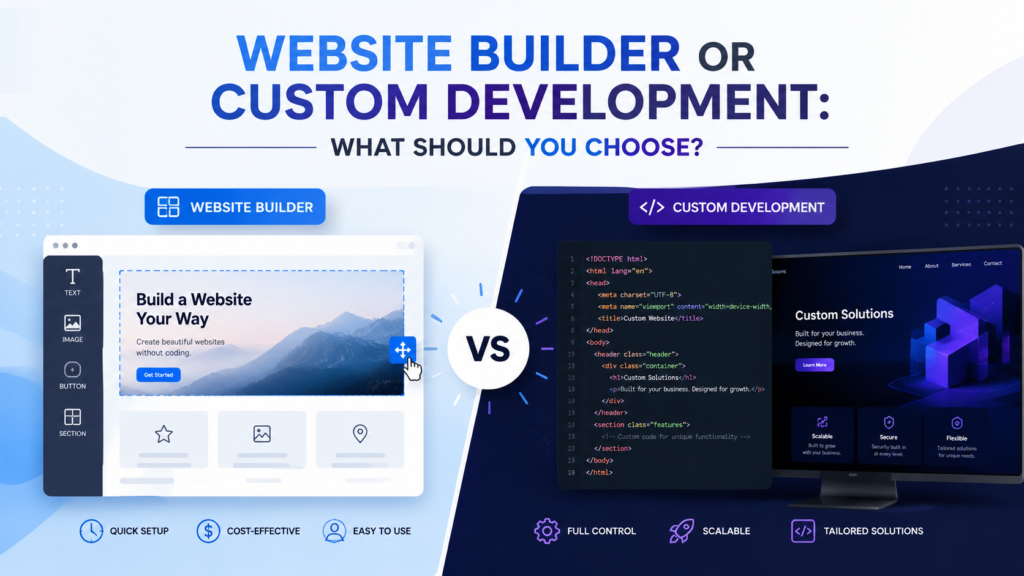
One of the most common questions in website creation is whether to use a website builder or invest in custom development. The answer depends on the project, not on the popularity of one option.
A website builder can be a smart choice for many small businesses, freelancers, consultants, and service providers. Custom development can be necessary for more complex projects with special functionality, unusual logic, or advanced integrations.
The real goal is not to choose the most impressive option. The goal is to choose the option that fits the website’s purpose, budget, and long-term maintenance.
What Is a Website Builder?
A website builder is a platform that allows users to create websites with ready-made tools, templates, visual editing, and built-in features. It reduces the need for manual coding and makes website creation more accessible.
Website builders are often useful for:
Small business websites
Personal websites
Service pages
Landing pages
Portfolios
Simple blogs
Local business pages
Event pages
Basic company websites
The main advantage is speed and manageability. A business owner can launch a professional-looking site without building everything from zero.
What Is Custom Development?
Custom development means building a website or web system with code and a more individualized technical structure. It may involve frontend development, backend development, databases, integrations, custom admin panels, and advanced functionality.
Custom development is useful when the website needs features that standard platforms cannot easily provide.
Examples include:
Complex booking systems
Custom user accounts
Advanced marketplaces
Unique calculators or tools
Large databases
Custom workflows
Deep integrations with business systems
Special performance or security requirements
Custom development gives more flexibility, but it usually requires more time, budget, and technical maintenance.
When a Website Builder Is Enough
A website builder is often enough when the website’s main goal is presentation and communication.
If you need to explain services, show examples, publish contact details, collect inquiries, and create a professional first impression, a builder-based website may work very well.
For example, a consultant may need a homepage, about page, services page, blog, and contact form. A local business may need service descriptions, location details, reviews, and a quote request form. A freelancer may need a portfolio and a contact section.
These types of websites do not always need custom code. They need clarity, good structure, and consistent design.
When Custom Development Makes More Sense
Custom development becomes more important when the website is not just an information platform but a functional system.
If users need to log in, manage accounts, interact with custom tools, search complex databases, or complete unique workflows, a website builder may become limiting.
Custom development also makes sense when the business has very specific technical requirements or expects the website to become a core product, not just a marketing channel.
For example, a SaaS platform, marketplace, custom booking system, or internal business portal may require custom development from the beginning.
Budget Is Not the Only Factor
Many people choose a website builder because it is usually more affordable. That is a valid reason, but budget should not be the only factor.
Maintenance matters too. A custom website may be powerful, but it can require a developer for many updates. A builder-based website may be easier for the owner or team to edit.
Speed also matters. If a business needs to launch quickly, a website builder may be the practical option. If the project requires a unique system and has a longer timeline, custom development may be justified.
The best choice depends on the full situation: budget, timeline, features, content, updates, and future plans.
Think About Who Will Manage the Website
After launch, someone will need to update the website. This may include changing text, adding photos, publishing articles, updating services, or editing contact information.
If the business owner wants to manage these updates personally, a website builder can be useful. If the company has a technical team or works with developers regularly, custom development may be easier to maintain.
A website that is difficult to update often becomes outdated quickly. The maintenance process should be part of the decision.
Design Flexibility
Custom development usually offers more design freedom. A development team can create a unique layout, special animation, advanced interaction, or fully custom interface.
Website builders usually work within platform limits, but modern builders can still produce clean and professional designs. For many small business websites, the difference is not critical. Visitors care more about clarity, speed, trust, and usability than whether every pixel is custom-built.
If the website’s success depends on a very unusual interface, custom development may be better. If the website needs to look professional and communicate clearly, a builder may be enough.
SEO Considerations
Both website builders and custom websites can support SEO if they are structured properly. SEO depends on page logic, headings, content quality, metadata, internal links, performance, mobile usability, and technical accessibility.
A poorly planned custom website can perform badly. A well-structured builder website can perform well for many small business needs.
Before choosing a platform, think about whether it allows you to edit page titles, meta descriptions, headings, URLs, image alt text, and content sections. These basics matter.
How to Make the Decision
A simple way to choose is to ask what type of website you are building.
If you need a professional online presence with pages, services, contact forms, and basic content, a website builder may be enough.
If you need a web application, custom user logic, advanced integrations, or highly specific functions, custom development is probably better.
If you are unsure, start with the required functionality. Write down what the website must do. Then separate “must-have” features from “nice-to-have” ideas. Many projects become simpler when this distinction is clear.
Common Mistakes
One mistake is choosing custom development because it sounds more professional. For many small businesses, this can create unnecessary cost and complexity.
Another mistake is choosing a website builder for a project that clearly needs custom functionality. This can lead to limitations later.
A third mistake is choosing a tool before planning the content and structure. The platform should support the website plan, not replace it.
Final Thoughts
There is no universal answer to the website builder versus custom development question. A website builder is often the right choice for clear, practical, manageable business websites. Custom development is better for complex systems and unique functionality.
The best decision starts with the website’s purpose. What should it do? Who will use it? Who will update it? What features are truly necessary? How much flexibility is required?
When these questions are answered, the choice becomes much easier.